s谩bado, 4 de enero de 2020


Motivation and confidence are key factors in learning a foreign language

Related image

The importance of motivation in learning is indisputable. Motivation is a main ingredient when learning. It directly affects performance and helps knowledge be acquired faster and easier. This applies to all areas and, of course, also to languages.


Image result for confidenceConfidence is the key for those non-native English speakers who, with a very basic level of language, achieve the result of their message in the recipient, and effectiveness is born in the act. Learning a language is not about mastering it 100%, it is not about the precision with which a person speaks it. 

When you start studying a second language, the most frequent reasons are academic, work or personal interest. But these reasons are too broad, they are impossible to achieve in the short term and therefore, as we strive and do not finish seeing our goal fulfilled comes the discouragement

Here you have a motivational video about the confidence in learning a language, you will hear true reason why to be motivated is important.


Find out what your learning style is. Do you learn more by listening, reading, talking, playing? Power what you are best at and will contribute to your overall level.

Enjoy while you learn. Do things you like using the language you want to learn. Do not become obsessed with the typical exercises if you find them boring. They are useful, but you can alternate them with other activities. 

Find someone with the same interest. We all have better and worse moments and you can support and challenge each other to accelerate the results.

Communicate your intentions to the people around you, You will feel more pressure and want to fulfill what you have proposed.


Read this articles to get more info about this topic:


How to write texts properly in English?
馃挗

Image result for writing

Most English language exams have a written part of Writing in which students must demonstrate their ability to write in English. If you are preparing for an exam of this type (for example TOEFL), these tips will be very useful to pass with a good grade. These tips can not only be applied to exams, but also to your class work, even in your mother tongue. The characteristics of a well written text do not vary much from one language to another.

馃憖 Tips to improve your writing skills 馃憖

Read the statement carefully

This may seem obvious, but you should be very clear about what you are being asked for in the exercise and what you should answer.

Make a draft

If you can, take some notes on a piece of paper before writing the definitive answer.

Underline the keywords

This can help you better understand the subject.

Structure the text

Use paragraphs to separate ideas. Normally the structure of a text should be like this:
Introduction (a paragraph) It is the principle of the text, where the reader is informed of what will be discussed in it.
Development (one or several paragraphs, one for each idea or argument).
Conclusion (a paragraph) It is the summary of everything you have developed in the text (depending on the textual type it can be an evaluation, a summary, an opinion, etc.)+

Order and clarity

Do not mix different ideas in a messy way, distribute them according to the structure of the text.


Avoid redundancies

When you need to repeat a phrase that appears in the statement of the exercise, try to express it differently, so you will show that you have not only understood the exercise but also know how to express the same idea in different ways.

Link video to get information about it:


What is the TOEFL test and how to pass it?
馃槺


The TOEFL is one of the most used English proficiency exams in the world, and your qualification is used as a requirement to obtain academic degrees, make exchanges abroad, and even obtain Visas to visit some of the most important countries.

There are 2 types:

International: This is the official and has international validity. Whether you want to get a residence visa or study abroad, it is an indispensable requirement. It can be presented in two ways; iBT and PBT 

Institutional (also known as ITP): This is in pencil and paper, its validity is only nationally (sometimes only valid in the institution that made it).

Examine 5 skills:

Reading Comprehension: Its objective is to determine your level of compression when reading.

Listening Comprehension: Measure how well you understand spoken English.

Speaking: Evaluate your ability to express yourself orally in English. PBT mode does not include this section.

Writing: Determine how advanced your writing skills are.


Structure: Examine your grammar, the way you structure sentences and use vocabulary based on context. This section is of extreme importance in the iBT.


Image result for toefl


Tips to deal with the test

1. Learn how the exam works
Understanding that whole process well increases your score considerably.

2. Set a goal
When you start your preparation, set study schedules that you will follow weekly, as well as a calendar of the activities you have to do.

3. Perform Mock Exams
A Mock Exam is a test that will tell you the approximate grade you will get if you take the exam at this time.


Link to practice: https://www.ets.org/toefl/ibt/prepare/practice_sets/


Tips to improve and increase your vocabulary in English

馃檶

Image result for vocabulary


Words define the scope and depth of our understanding. Having a vocabulary quite rich in English is essential to master the language. Therefore, acquiring new vocabulary will help you improve your oral expression and comprehension skills in English.

1. Make learning new words a priority


Image result for people talkingThe process of learning and memorizing words must be constant, otherwise the words we learn and do not use are forgotten. Think that words are like seeds, but give them proper care they die. Learn at least 5 new words every day. It is better that you learn and memorize words little by little to try to memorize a lot every day.

2. Learn practical vocabulary

mejorar y aumentar tu vocabulario en ingl茅sStart with vocabulary with which you can express what is most important to you. For example, vocabulary related to your profession, occupation or hobbies. If you want to learn vocabulary about the sport you practice, identify the most used words in the rules and training.


3. Relate new vocabulary with images

mejorar y aumentar tu vocabulario en ingl茅s
Once you have written the new vocabulary you want to learn in a newspaper or in an app, the next step is to connect the sound of each word to its respective meaning. A good option is to relate the meaning of the word to the image of an object or an action. 

4. Use the new vocabulary actively and always remember it

mejorar y aumentar tu vocabulario en ingl茅s
The more something is remembered, the more it will last in the mind. I recommend, then, that you use the new vocabulary as much as you can. Include new words in different phrases. For example, when you are walking to your house, the subway station or when you are at a traffic light, remember the word and create a dialogue with it.

Link video:   馃挰
´


Present Perfect


Image result for present perfect
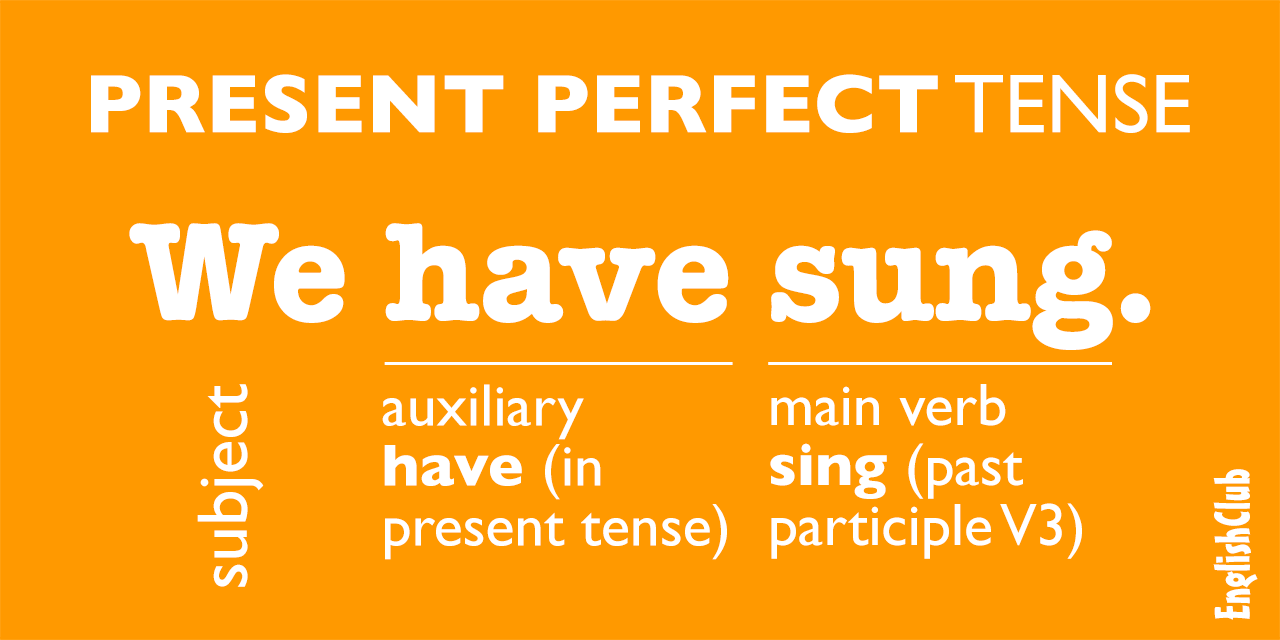
The present perfect equals more or less the perfect past of Spanish. We will see the differences in the section on uses. In general, it is a mixture between the present and the past. We use it for actions in the past that are important in the present.


Form 馃憖

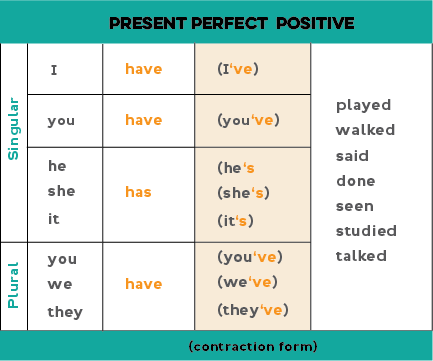
To form the present perfect, the auxiliary verb "to have" is used in the present and the past participle of the verb. For regular verbs, the past participle is the simple form of the past. See the lesson on the past simple for more information on how to form the past.

Structure  ✌

Image result for present perfect


Examples: 


I haven’t talked to Peter.
She hasn’t gone to work.
We haven’t been to London.


They haven’t learned English.


USES


1. The present perfect is used to describe an experience. We do not use it for specific actions.

2. The present perfect is used for a change in time.

3. It is used for successes or achievements.

4. The present perfect is used to talk about actions at different times in the past.


Links to practice:

https://www.perfect-english-grammar.com/present-perfect-exercises.html


https://www.ego4u.com/en/cram-up/grammar/present-perfect-simple/exercises


Video for more detailed info:


馃懢    Learn English Watching Cartoons   馃懢

Image result for cartoons


You are right, you can learn English watching cartoons. This multimedia resource can be applied for education and improve language skills.


Many cartoons are suitable for people of all ages. Also, not all of these programs are suitable for children. For example, The Simpsons and Family Guy are cartoons, but they contain violence and inappropriate jokes for the youngest.

Reasons for watching cartoons and learn English 

  • The voice actors speak clearly. That means they pronounce the words very well so that everyone understands them.


  • Many Cartoons are focus on social interactions. That way, you can listen to realistic conversations and phrases.


  • Cartoons use words simple enough for a beginner to understand, although they sometimes have challenging terms for more advanced students.


  • If you watch a program for young children, you will discover that words, phrases and even complete sentence structures are often repeated.


  • The programs are usually short, only 20 minutes long. Sometimes, each episode is divided into two parts of 10 minutes.


  • There are cartoons made specifically to teach new words and phrases!


There are specific Instagram accounts for learning English through short videos with a transcription in English and Spanish.

馃憖     https://www.instagram.com/spanish.toons/


Watch complete cartoon episodes in Youtube. There are thousand of them!

馃挜    https://www.youtube.com/watch?v=3IBpZyOUh5A


Reading Techniques

SKIMMING & SCANNING

Image result for reading png

Skimming and scanning are reading techniques that use rapid eye movement and keywords to move quickly through text for slightly different purposes. Skimming is reading rapidly in order to get a general overview of the material. Scanning is reading rapidly in order to find specific facts. While skimming tells you what general information is within a section, scanning helps you locate a particular fact. Skimming is like snorkeling, and scanning is more like pearl diving.
Use skimming in previewing (reading before you read), reviewing (reading after you read), determining the main idea from a long selection you don't wish to read, or when trying to find source material for a research paper.
Use scanning in research to find particular facts, to study fact-heavy topics, and to answer questions requiring factual support.

Skimming to save time  馃憣

Skimming can save you hours of laborious reading. However, it is not always the most appropriate way to read. It is very useful as a preview to a more detailed reading or when reviewing a selection heavy in content.
Use skimming to overview your textbook chapters or to review for a test. Use skimming to decide if you need to read something at all, for example during the preliminary research for a paper.

Scanning for research and study 馃憤

Scanning, too, uses keywords and organizational cues. But while the goal of skimming is a bird's-eye view of the material, the goal of scanning is to locate and swoop down on particular facts.
Scanning is a technique that requires concentration and can be surprisingly tiring. You may have to practice at not allowing your attention to wander. Choose a time and place that you know works for you and dive in.


Links to practice:
More info about skimming and scanning: